
The standard advice is sound and it is not complicated. What follows is the whole plan in four steps, with a worked example — plus the part that usually gets skipped: keeping your debt tracker accurate once real payments start landing.
Step 1: Stop adding to the pile
Paying down debt while still taking on new debt is running up a down escalator. Before anything else, the inflow has to stop.
In practice that means two things: knowing where your money currently goes, and keeping a small cash buffer for the unexpected. Most new debt is not frivolous — it is a car repair or a medical bill landing in a month with nothing spare. Even a modest emergency fund absorbs that hit instead of turning it into another line on your list. If you want a simple structure for building one, the 50/30/20 rule puts savings in its own bucket by default.
Step 2: Write down every debt — including the awkward ones
List all of them, with the amount still outstanding and who it is owed to. The important instruction here is the one most guides leave implicit: include informal debts. Money borrowed from a friend, a parent, a coworker who covered something months ago — these count.
They get left off lists because they feel too small or too personal to write down. That is exactly why they should be on it. They are usually the smallest amounts, which makes them the fastest to clear, and no statement will ever arrive to remind you they exist.
Step 3: Clear the smallest one first
Order the list by remaining balance, smallest at the top. Keep up with whatever you owe on the rest, and put every spare dollar on the smallest one until it is gone. Then take the money you were putting toward it and roll it into the next one.
Here is what that looks like with $400 a month available:
- A friend, concert tickets — $120
- Your sister, car repair — $450
- Phone financing — $800
- Family loan — $2,000
That is $3,370 total, which looks like a long road. But because you attack it in order:
- Month 1 — the friend is paid off. One debt gone in the first month.
- Month 2 — your sister is paid off. Half the list is clear.
- Month 4 — phone financing is done.
- Month 9 — the family loan clears. Debt-free.
Two of the four debts are gone inside two months. That is the entire point: the early wins come fast, and each one hands its payment to the next debt, so the back half moves quicker than the front half. A big number becomes a short list that keeps getting shorter.
Step 4: Keep your debt tracker accurate (the step nobody mentions)
Steps 1–3 are standard advice. Step 4 is where plans actually die, and it gets almost no attention.
A debt list is only useful while it is true. It stops being true the moment real life touches it: someone pays you back $50 of $200 in cash and nobody writes it down. You hand your sister $80 toward the $450. Six weeks later you have two numbers in two heads and no way to settle which is right. When the list is wrong, "pay the smallest first" stops working — because you no longer know which one is smallest.
So whatever you use as a debt tracker — app, spreadsheet, notebook — it needs three things:
- The remaining balance, not the original amount. The starting figure becomes misinformation the moment a partial payment happens.
- A dated record of every payment. This settles "didn't I already pay some of that back?" in seconds, without either person needing a perfect memory.
- A due date with a reminder. Informal debts have no deadline attached, which is precisely why they get repaid last. Adding one fixes that.
And keep what you owe separate from what is owed to you. Collapsing them into a single number hides which debts are close to done — and finishing debts is the whole strategy.
Where MoniTabs fits
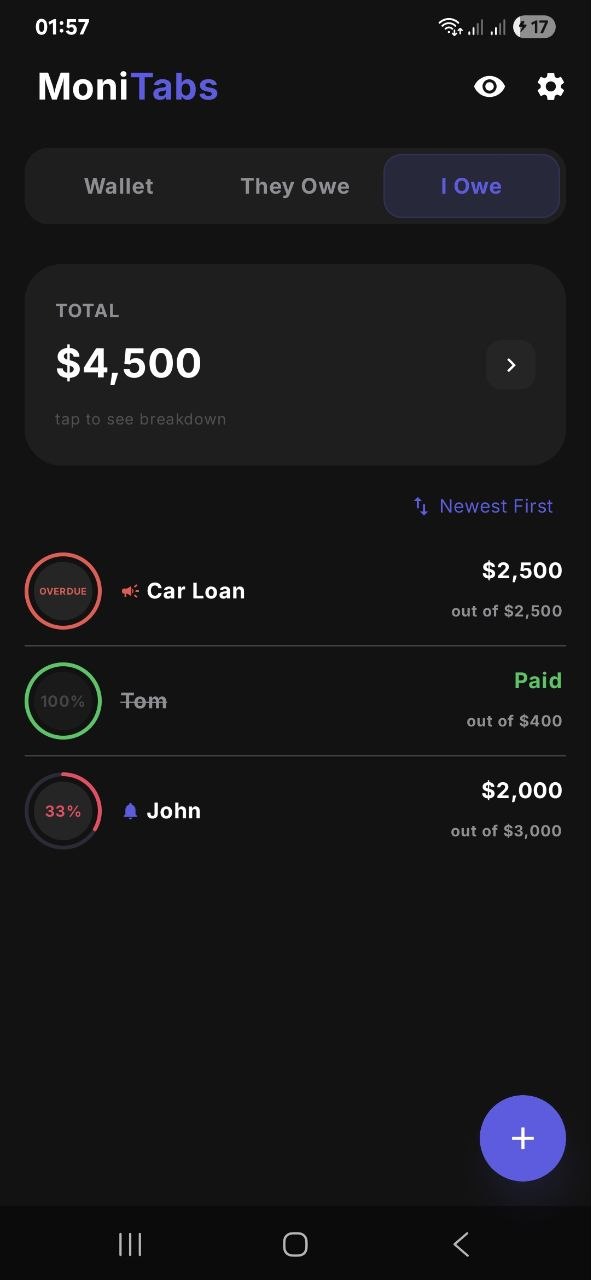
MoniTabs is a debt tracker built for step 4. I Owe lists every debt you need to pay back with its remaining balance, a dated repayment timeline, notes, and reminders — so the smallest debt is always obvious at the top, and it stays accurate as partial payments land. They Owe does the same for money others owe you, with partial repayments, reminders, and PDF export when you need to share a clean record instead of reconstructing one from memory.
Overdue debts are flagged automatically, which matters most for the informal ones — those rarely go unpaid on purpose, they just drift past a date nobody was watching. Everything stays on your device, no account required.
Frequently asked questions
Which debt should I pay off first?
Start with the smallest remaining balance. Clearing it completely frees up whatever you were paying toward it, and gives visible proof the plan is working, which is what makes people stick with it.
Should I include money I borrowed from friends and family?
Yes. Informal debts are usually the smallest on the list, which makes them the fastest wins, and they are the ones most likely to be forgotten because no statement or reminder ever arrives for them.
What should a debt tracker show?
A good debt tracker shows the remaining balance rather than the original amount, records each partial repayment with a date, supports due dates with reminders, and keeps money you owe separate from money owed to you.
How do I track a debt being paid back in installments?
Record each payment against the original amount as it happens, so the remaining balance updates automatically. A single "paid back" checkbox stops being accurate the moment repayment happens in parts.